

LID
Collection
A curated collection of language identification models, including specialized solutions for Nigerian and multilingual contexts. • 9 items • Updated

lid-lite-608 is a fast, CPU-only language identification model for 608 languages, built African-first, with the following key features:
lid-lite-608 has the following features:
dim=128, quantized)zxx_Zxxxyor_Latn, srp_Cyrl (full list in labels.json)model.ftz)For the highest accuracy, especially on short and conversational input, see the neural sibling lid-neural-608 (mmBERT, same 608 languages, labels and modes).
pip install fasttext huggingface_hub
import json, math, fasttext
from huggingface_hub import hf_hub_download

repo = "olaverse/lid-lite-608"
model = fasttext.load_model(hf_hub_download(repo, "model.ftz"))
calib = json.load(open(hf_hub_download(repo, "priors.json")))
traffic_bias = {l: calib["alpha"] * v for l, v in calib["log_prior_ratio"].items()}

def identify(text, mode="coverage"):
    text = " ".join(text.split())                      # fastText needs a single line
    k = 40 if mode == "traffic" else 1
    labels, probs = model.predict([text], k=k)         # list input: works with NumPy 1 and 2
    labels, probs = labels[0], probs[0]
    scores = {l[9:]: math.log(max(p, 1e-12)) + (traffic_bias.get(l[9:], 0.0) if mode == "traffic" else 0.0)
              for l, p in zip(labels, probs)}
    return max(scores, key=scores.get)

identify("Ẹ kú àárọ̀, ṣé dáadáa ni?")                   # 'yor_Latn'
identify("Habari za asubuhi")                          # 'swh_Latn'
identify("Bonjour mon ami", mode="traffic")            # 'fra_Latn'
olaverse library
The olaverse library (v0.4.1+) wraps the model, the priors and both modes:
pip install "olaverse[lid]"
from olaverse import LIDLite608

lid = LIDLite608()                                     # mode="coverage" (default)
lid.predict("Ẹ kú àárọ̀, ṣé dáadáa ni?")               # 'yor_Latn'
lid.predict_proba("Habari za asubuhi", top_k=3)        # {'swh_Latn': 0.916, 'swc_Latn': 0.084, 'hau_Latn': 0.0}
lid.predict_batch(["Habari za asubuhi", "Mo fẹ́ lọ sí ọjà lónìí"])   # ['swh_Latn', 'yor_Latn']

lid.predict("Bonjour mon ami")                         # 'dhv_Latn'  (coverage: every language equally likely)
LIDLite608(mode="traffic").predict("Bonjour mon ami")  # 'fra_Latn'  (traffic: leans to common languages)
Newlines are collapsed for you, empty text raises ValueError, and it works with NumPy 2. Its predictions match
the code above exactly (checked on 20,000 held-out texts in both modes).
One model, two ways to read its output:
mode="coverage" (default)
Every language is treated as equally likely. Use it when every language matters, such as mining low-resource text from a web crawl or building corpora. Highest per-language accuracy (macro-F1 0.856).
mode="traffic"
Scores are adjusted by each language's real-world frequency (priors.json), so short or ambiguous
input leans toward the languages that actually dominate everyday traffic. Use it for user input,
search queries, chat and request routing: +2.2 pts web-weighted accuracy and +6.6 pts on 1-5 word
inputs compared with coverage mode.
Both models share the same 608 languages, labels and coverage/traffic modes.
| lid-lite-608 | lid-neural-608 | |
|---|---|---|
| Size | 37 MB | 140M parameters (~560 MB) |
| Speed | ~6,800 texts/s on one CPU thread | |
| Held-out test, accuracy | 0.858 | 0.867 |
| 1-5 word inputs, traffic mode (web-weighted) | 0.829 | 0.906 |
| Everyday phrases, traffic mode | 0.838 | 0.943 |
| Best for | Bulk filtering, CPU-only and edge deployments | User input, short text, highest accuracy |
Use both: run lid-lite-608 as a fast first pass and send only short or uncertain inputs to lid-neural-608.
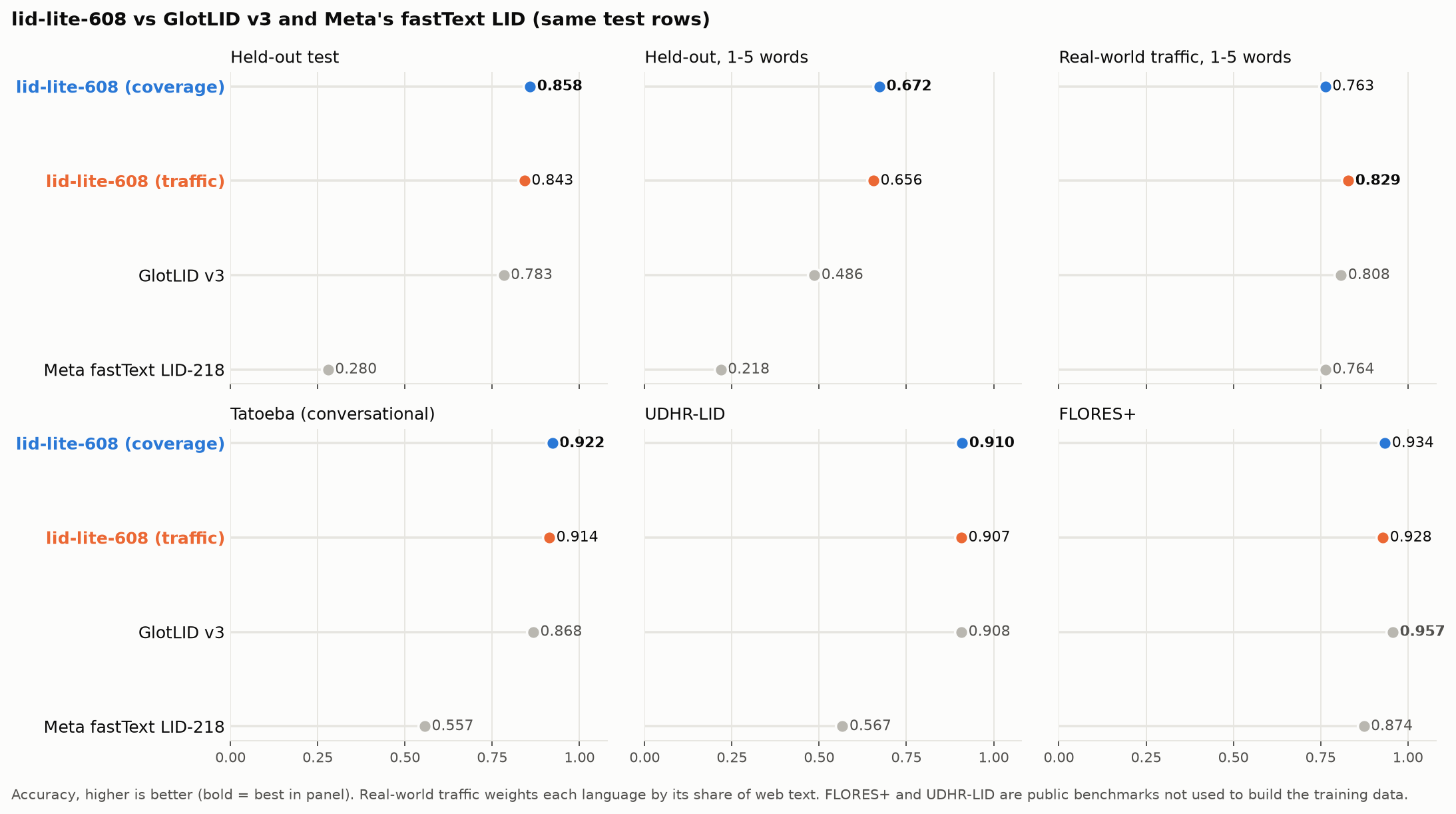
All models scored on the same data. Other models' language codes are mapped to ours and they are scored on their best guess among our 608 languages, so naming differences never count as errors.
| lid-lite-608 (coverage) | lid-lite-608 (traffic) | GlotLID v3 | Meta fastText LID-218 | |
|---|---|---|---|---|
| Model size | 37 MB | 37 MB | 1,687 MB | 1,176 MB |
| Licence | Apache-2.0 | Apache-2.0 | Apache-2.0 | CC-BY-NC-4.0 |
| Held-out test, accuracy (240k) | 0.858 | 0.843 | 0.783 | 0.280 |
| Held-out test, macro-F1 | 0.856 | 0.843 | 0.795 | 0.182 |
| Held-out test, 1-5 words | 0.672 | 0.656 | 0.486 | 0.218 |
| Web-weighted accuracy | 0.932 | 0.954 | 0.946 | 0.901 |
| Web-weighted, 1-5 words | 0.763 | 0.829 | 0.808 | 0.764 |
| Tatoeba (conversational, 34k) | 0.922 | 0.914 | 0.868 | 0.557 |
| UDHR-LID (291 languages) | 0.910 | 0.907 | 0.908 | 0.567 |
| FLORES+ devtest (202 languages) | 0.934 | 0.928 | 0.957 | 0.874 |
| FLORES+ first 1-5 words | 0.708 | 0.708 | 0.692 | 0.618 |
| lid-lite-608 (coverage) | lid-lite-608 (traffic) | GlotLID v3 | Meta fastText LID-218 | |
|---|---|---|---|---|
| Held-out test | 0.900 | 0.897 | 0.885 | 0.822 |
| Held-out test, 1-5 words | 0.749 | 0.750 | 0.681 | 0.628 |
| Tatoeba | 0.937 | 0.939 | 0.911 | 0.858 |
| FLORES+ first 1-5 words | 0.732 | 0.735 | 0.724 | 0.684 |

| Words | lid-lite-608 | GlotLID v3 |
|---|---|---|
| 1-5 | 0.672 | 0.486 |
| 6-20 | 0.871 | 0.796 |
| 21-80 | 0.924 | 0.902 |
| 81-256 | 0.944 | 0.942 |
| Noise / junk (F1) | 0.961 | 0.620 |
| Language | lid-lite-608 | GlotLID v3 | Language | lid-lite-608 | GlotLID v3 | |
|---|---|---|---|---|---|---|
Yoruba yor |
0.906 | 0.827 | Kinyarwanda kin |
0.758 | 0.371 | |
Hausa hau |
0.881 | 0.806 | Kirundi run |
0.687 | 0.724 | |
Igbo ibo |
0.896 | 0.853 | Lingala lin |
0.814 | 0.642 | |
Nigerian Pidgin pcm |
0.776 | 0.749 | Twi twi |
0.785 | 0.732 | |
Swahili swh |
0.808 | 0.719 | Ewe ewe |
0.753 | 0.738 | |
Amharic amh |
0.985 | 0.939 | Fon fon |
0.904 | 0.841 | |
Zulu zul |
0.743 | 0.761 | Wolof wol |
0.809 | 0.600 | |
Xhosa xho |
0.840 | 0.602 | Somali som |
0.910 | 0.826 | |
Oromo gaz |
0.761 | 0.741 | Shona sna |
0.882 | 0.855 | |
Luganda lug |
0.906 | 0.867 | Tigrinya tir |
0.984 | 0.956 | |
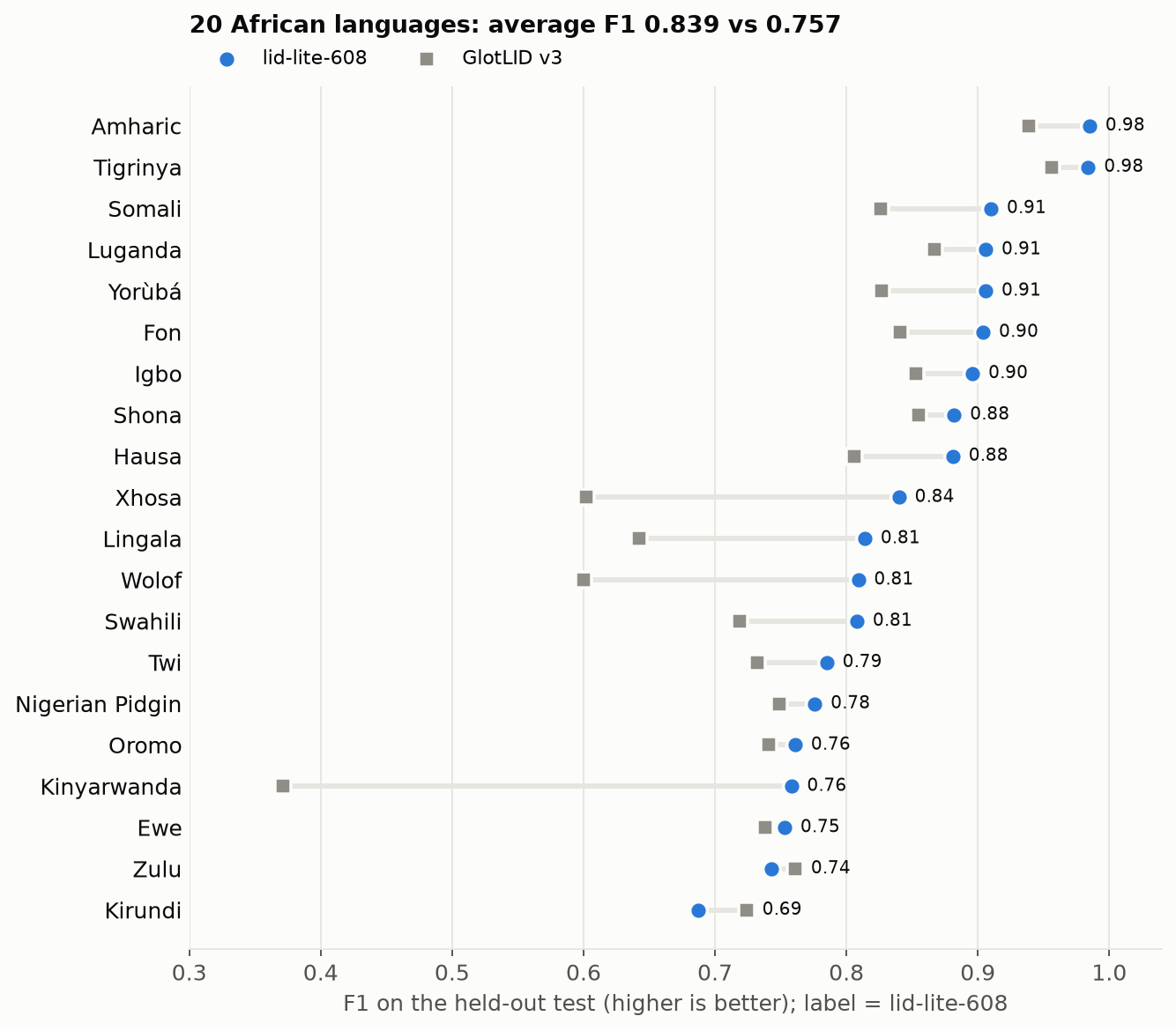
| Average | 0.839 | 0.757 |
F1 across all input lengths, including 1-5 words.
About the test sets. Held-out test: 100 samples per length bucket per language, from websites
never seen in training. Web-weighted: the same test with each language weighted by its share of
web text, approximating real-world traffic. Tatoeba: held-out everyday sentences. FLORES+ and
UDHR-LID: public benchmarks not used to build our data. Full tables and per-language results are
in eval/.
zxx_Zxxx marks numbers, URLs, code and other non-language text; drop or
route it separately.Trained from scratch on 7.86M samples from FineWeb-2 and MADLAD-400 (ODC-By 1.0), Aya Dataset and WURA (Apache-2.0), MasakhaNews (AFL-3.0) and Tatoeba (CC-BY 2.0 FR, sentences © Tatoeba contributors, https://tatoeba.org). Religious text, wrong-script text, mislabelled documents and foreign boilerplate were filtered out. Released under Apache-2.0.
@misc{lid-lite-608,
  title  = {lid-lite-608},
  author = {Olaverse},
  year   = {2026},
  url    = {https://huggingface.co/olaverse/lid-lite-608}
}